David Whyte on Preserving the Soul (1994)
Thank you Kunel!
Recall.it (detailed summary)
The Conflict Between Rationality and Creativity in the Workplace
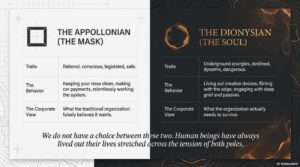
- Modern workplace environments often encourage individuals to limit their identity to the Apollonian aspect of human nature, which represents the rational and conscious self (00:00:37).
- By focusing exclusively on rational identity, individuals frequently neglect the Dionysian side of their nature, which encompasses the underground energies essential to human character and creativity (00:00:56).
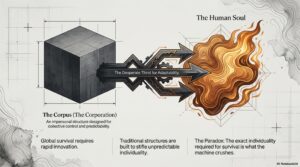
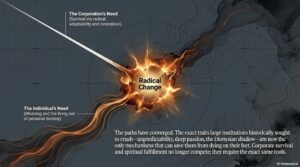
- A significant intersection exists between the needs of modern corporations, which require increased adaptability and creativity to survive in a global market, and the human desire to fulfill individual creative destinies (00:01:18).
- Poetry serves as a practical tool for understanding complex workplace phenomena, including the dynamics of human creativity and self-sabotage (00:01:56).
- While corporations are increasingly demanding creativity for survival, they have historically functioned to stifle individuality and the soul, a tension often reflected in literature regarding the “man in the gray flannel suit” (00:02:18).
Corporate Structure and the Individual Soul
- The term “corporation” is derived from the Latin word “corpus,” meaning a body, and is intended to facilitate collective actions that individuals cannot accomplish alone (00:02:45).
- Individuals, including company founders, often find themselves caught in an impersonal corporate structure that was originally created to achieve personal goals (00:02:57).
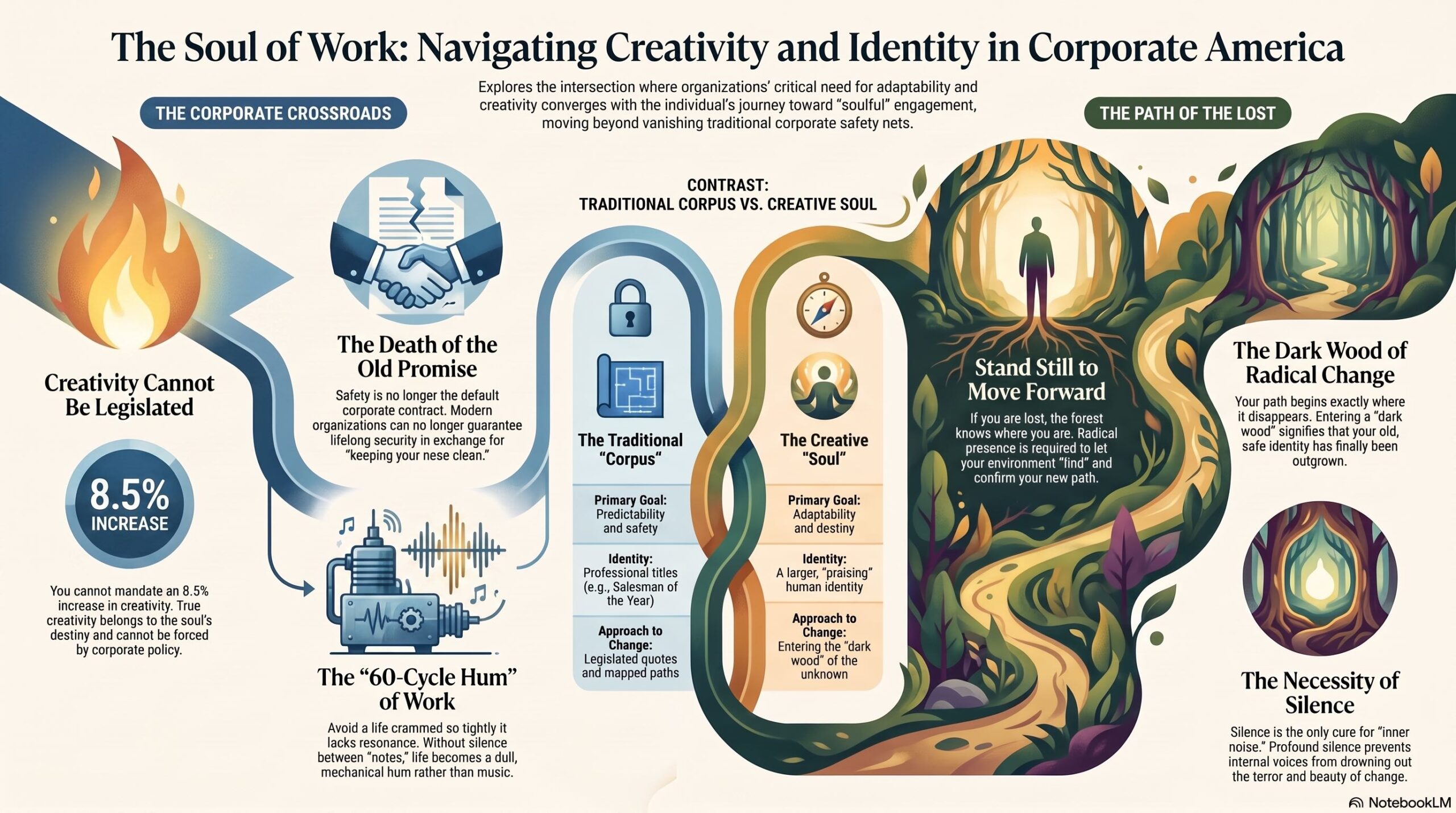
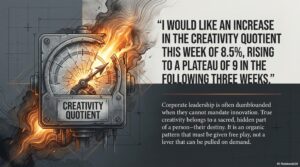
- Corporations often struggle to foster creativity because it cannot be legislated or mandated through quantitative targets (00:03:19).
- Creativity is linked to a sacred, hidden aspect of the individual and is tied to the soul’s destiny, which seeks to express its unique pattern in whatever environment a person inhabits (00:03:42).
- Because individuals in North America spend more time in the workplace than in other settings like family, church, or the wilderness, the workplace has become a primary environment for the expression of one’s personal pattern (00:04:05).
The Convergence of Corporate Needs and Personal Destiny
- Modern work environments must become more nourishing to the human soul, or society faces significant trouble (00:04:18).
- A convergence exists where corporations are currently seeking adaptability and creativity in individuals, which are the same qualities historically valued in human beings (00:04:31).
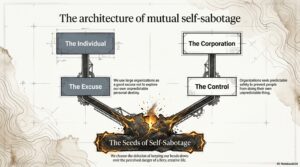
- Both corporations and individuals often fear this convergence because large organizations can serve as an excuse for individuals to avoid pursuing their personal destiny, while corporations use control to prevent employees from acting independently (00:04:43).
- Both the individual and the corporation carry the potential for self-sabotage in their pursuit of something different (00:05:14).
Reconciling Danger and Stability in Artistic Life
- Historically, many creative artists, particularly during the Romantic period, have been associated with flirting with danger, self-destruction, and death (00:05:18).
- The image of the self-destructive artist, such as Dylan Thomas, is often used as a defense mechanism to keep people safe from their own potential for artistry (00:05:50).
- Contrary to the stereotype of the “meteoric crash,” history shows that many great artists were sane individuals who maintained families and lived stable lives (00:06:22).
- The societal tendency to force a choice between being a dangerous artist or a person who keeps their “nose clean” and focuses on mundane responsibilities is a false dichotomy (00:06:37).
- Human existence is defined by living between the two poles of danger and stability (00:06:59).
The Role of Discordance and Silence in Human Experience
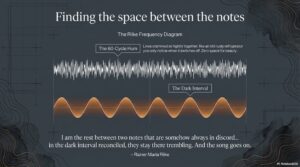
- A poem by Rilke, translated by Robert Bly, illustrates that life is the “rest” between two discordant notes—life and death—that remain reconciled in a trembling interval (00:07:04).
- The discord between these two notes is what allows for the creation of beauty and gives music its power (00:08:00).
- People often focus too much on being the “notes” themselves, failing to allow for the necessary space between them that provides the music with its strength (00:08:13).
- Modern life is characterized by a sense of discordance, including the rush of traffic, urban decay, and environmental pollution, which creates a constant, underlying hum that is only noticed when it stops (00:08:27).
- While life has always been difficult, the challenges are now collectively felt on a global scale, and in some regions, the crises that were once feared as future catastrophes have already arrived (00:08:58).
Poetry as a Tool for Organizational and Personal Transformation
- There is a growing realization that the delusion of ignoring the larger picture of life is no longer sustainable (00:09:17).
- Within large organizations, such as AT&T, Ford Motor Company, and Stanford University, there is a profound sense of desperation among employees who are seeking more satisfying, real, and alive experiences (00:09:37).
- Poetry serves as a successful tool for addressing these needs because it does not merely talk about an experience, but rather creates the experience itself within the room (00:10:05).
- Human beings have sought creative change for millennia, and poets have left behind immortal works that speak to every generation (00:10:43).
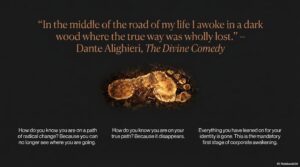
- Dante’s Divine Comedy offers a precise roadmap for radical change, specifically the realization that one is on the right path when the path itself disappears and one cannot see where they are going (00:11:04).
- Embarking on a radical new path often involves losing the foundations of one’s previous identity and entering a period of self-doubt (00:11:53).
- When these poetic insights are shared, individuals often recognize their own lives within the verses, finding the experience astonishing (00:12:15).
- Beyond Dante, many other poets have left “footprints in the snow” that provide guidance for navigating the stages of life (00:12:27).
Learning to Navigate the Unknown Through Poetic Wisdom
- Poets are sometimes described as technicians of the sacred. (00:12:41)
- David Wagoner, a chair of poetry at the University of Washington, wrote a poem titled “Lost” that incorporates a teaching story from the Northwest Indian tradition. (00:12:48)
- The story addresses the life-or-death question of what a person should do when lost in the dense, 150-foot-high climax cedar forests of the Northwest, where cardinal directions are obscured. (00:13:01)
- The guidance provided in the poem is applicable to various modern situations, such as being lost in a large organization or as a street kid in Philadelphia. (00:13:23)
- While some avoid exploring the psyche due to perceptions of it being disorganized or concerns regarding professional liability, poetry demonstrates that the inner world is precise, though governed by dynamic and movable rules. (00:13:42)
The Lesson of Standing Still in the Forest
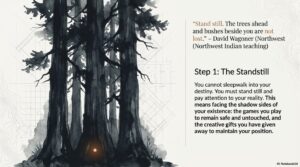
- The elder in the story instructs the lost individual to stand still, noting that the surrounding trees and bushes are not lost. (00:14:16)
- The teaching emphasizes that one must treat their current location as a “powerful stranger,” asking permission to know it and be known by it. (00:14:30)
- The forest is described as a breathing entity that creates the space around the individual, and the individual must recognize the unique nature of every tree and branch to avoid being lost. (00:14:44)
- The poem concludes with the instruction to stand still and allow the forest to find the individual. (00:15:01)
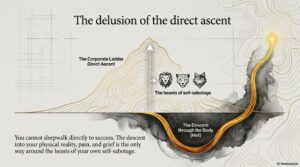
- The first lesson of the poem is that one cannot sleepwalk into their destiny; they must wake up and pay attention to their surroundings, including the shadow sides of their existence. (00:15:17)
- Paying attention requires acknowledging the parts of oneself sacrificed for safety in the workplace, the games played to remain untouched, and one’s creative gifts. (00:15:37)
Silence and Attention as Pathways to Change
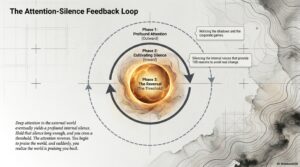
- The second lesson involves the necessity of silence, as the ability to experience silence is required to pay real attention. (00:16:02)
- Without the capacity for silence within the body, internal voices may become too frightening and drown out the possibility of real change. (00:16:35)
- Individuals often face numerous internal reasons and voices that discourage them from making significant life changes (00:16:49).
- Achieving profound silence is necessary to move past these internal obstacles and gain a deeper understanding of one’s underlying emotions, such as grief regarding a workplace (00:16:56).
- Poetry can serve as a tool to awaken an intuitive sense within an individual (00:17:15).
Interconnectedness and the Expansion of Identity
- The concept that “the forest knows where you are” and that one must “let it find you” reflects a broader theme of interconnectedness (00:17:23).
- This idea aligns with Zen traditions, which suggest that enlightenment occurs when the “10,000 things” come to confirm the individual, rather than the individual seeking to confirm them (00:17:35).
- Similar perspectives on the interconnectedness of the world are found in the teachings of Salish elders (00:17:45).
- Experience as a naturalist in the Galapagos Islands provided a practical understanding of this connection, cultivated through long periods of contemplative attention toward wild creatures (00:17:59).
- Deep, sustained attention to the natural world can lead to a threshold where the individual realizes that the world is paying attention back to them (00:18:33).
- While some might label this experience as animism, it is more accurately described as a natural human state that emerges when one experiences profound silence and allows the world to come alive (00:19:02).
- When attention reaches a sufficient depth, it manifests as praise for the world, which is then reciprocated by the world (00:19:25).
- This reciprocal praise is directed toward a larger identity than the one the individual held at the start of the process (00:19:38).
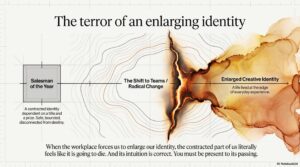
- The realization of this larger identity can be frightening, as the smaller, original self correctly senses that it must “die” to accommodate this expansion (00:19:52).
Confronting the Shadow and Embracing Full Existence
- This mystical, contemplative experience of identity expansion is analogous to the challenges faced in a workplace environment (00:20:14).
- Workplace transitions, such as moving from individual competition to team-based structures, can threaten an employee’s identity if that identity was previously tied to individual achievements and rewards (00:20:25).
- Individuals often restrict their expansive potential by funneling their life experiences into narrow, singular roles, such as achieving professional accolades, rather than embracing a creative life lived at the edge of their capabilities (00:20:59).
- Dante’s journey in his poetry illustrates that one cannot bypass the difficult aspects of existence to reach a higher state; he was forced to confront hell, represented by the lion, the leopard, and the wolf, which symbolize disowned parts of the self (00:21:33).
- The descent into hell serves as a metaphor for the challenge of fully inhabiting one’s body, a process that can feel painful because people often distance themselves from their physical selves to avoid the grief and pain inherent in living (00:22:06).
- Without guidance from elders who validate the necessity of grief and pain, individuals struggle to accept these experiences as part of a full life (00:22:32).
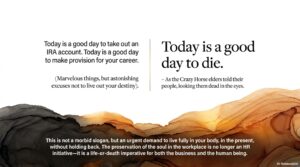
- The perspective of Crazy Horse’s elders, who taught that “every day is a good day to die,” emphasized the importance of living fully in the present moment rather than focusing solely on abstract future security (00:22:47).
- Modern societal focus on financial planning and career stability, while practical, often serves as an excuse to avoid the soul’s deeper call to live out one’s true destiny (00:23:07).
The Shifting Landscape of Corporate Employment
- Corporations are increasingly open to discussing previously forbidden, soul-oriented topics because they recognize that fostering creative, evolving work teams requires the presence of fully alive human beings (00:23:30).
- Working within the corporate environment is valued for its practicality, as it requires one to be genuinely useful to the organization to remain involved (00:23:45).
- Organizations only engage with these deeper human elements out of necessity, as the process can be difficult and emotionally taxing (00:24:03).
- Employees must understand their own shadow sides to avoid retreating into passive, obedient roles when faced with challenges, a tendency that can lead to organizational decline and a sense of helplessness (00:24:39).
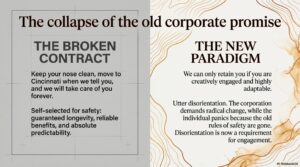
- Within sectors like the healthcare system, many individuals, particularly in lower middle management, are self-selected for safety rather than for the risk-taking required for meaningful change (00:25:08).
- Employment in healthcare organizations was historically motivated by both the moral desire to help others and the provision of comprehensive benefits, such as medical and dental plans (00:25:19).
- Workers previously viewed healthcare as a stable, long-term industry that would provide lifelong security (00:25:30).
The Breakdown of Traditional Employment Promises
- Organizations are currently unable to fulfill past promises of long-term care and job security for employees who follow company directives (00:25:38).
- The traditional employment contract, which suggested that employees would be taken care of if they remained loyal and followed instructions, is no longer being honored by corporations (00:25:50).
- Corporations are shifting their expectations, now requiring employees to be creatively engaged rather than simply following traditional career paths (00:25:56).
- Individuals often experience fear and resistance when corporations attempt to implement significant changes (00:26:04).
- Employees frequently feel betrayed because the current corporate environment does not align with the promises made to previous generations or the commitments made to them when they were first hired (00:26:12).
- The terror associated with the breakdown of these traditional employment promises may be serving as a catalyst for the awakening of soulfulness (00:26:17).
NotebookLM Infographics
Self-Sabotage?
David Whyte describes self-sabotage as a phenomenon that occurs when both individuals and organizations carry a longing for change but simultaneously harbor the seeds of their own undoing (00:05:14) [5].
Key insights from his discussion include:
- Fear of Creativity: He notes that corporations often ask for more creativity but are “dumbfounded” when they realize they cannot legislate it (00:03:12) [8]. Because creativity belongs to a “sacred hidden part” of a person’s destiny, it cannot be forced into a weekly quota (00:03:42) [8].
- The Artist Archetype: Whyte suggests we often use images of “meteoric” and self-destructive artists (like Dylan Thomas or Oscar Wilde) as a way to keep ourselves safe from our own artistry (00:05:50) [5][11]. By focusing on the danger and “crashes” of famous artists, we justify keeping our own heads down and playing it safe to avoid a similar fate (00:06:45) [11].
- Self-Selection for Safety: In systems like healthcare, he observes that many people in management are “self-selected for safety” (00:25:08) [12]. This leads to a situation where everyone feels helpless to make necessary changes, even when they know the “whole machine is going the wrong way” (00:24:55) [12].
- The Shadow Side: He argues that for a team to be truly creative and alive, individuals must understand their “shadow sides” (00:24:34) [12]. Without this awareness, people tend to run and hide at the first sign of a “scary little corner,” retreating into the safety of just doing what they are told for a salary (00:24:39) [12].
Tangent (-;